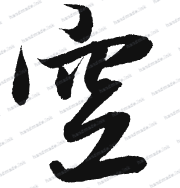
空 (kōng) — Emptiness / Space
Single-character Chinese tattoo · verified meaning · emptiness & space theme
Browse all 空 glyphs ↗Meaning & Nuance
空 (kōng) means “empty,” “void,” or “space” — and in Buddhist and Daoist usage it is not nothingness to fear but a fertile openness, the clear sky that holds everything. It pairs with 无 (wú) in 空无 but stands on its own as the spaciousness that makes life possible. As a tattoo it speaks to letting go, to calm, and to the freedom found in not-clinging.
Pronunciation & Form
Pinyin: kōng — a first-tone (high, level) syllable, steady and even like a held breath. The character places the 穴 (cave/roof) radical on top over 工 (work), visually a hollowed space beneath a roof.
Common Words & Phrases
Why Get 空 as a Tattoo
空 appeals to people drawn to minimalism, meditation, or a letting-go mindset. As a tattoo it is striking in its simplicity — one character that says “space,” “breath,” “openness.” It reads clearly to Chinese readers and pairs with 无 (wú) or 心 (xīn) for deeper philosophical layering. Its balanced square shape holds up well even at small sizes.
Tattoo Style & Placement
Best fits: fine-line, minimalist, or calligraphic brush. 空 is a clean, symmetric character that works as a single mark on the wrist, collarbone, behind the ear, or the upper arm. A large brush 空 on the back or ribs makes a bold contemplative statement. Keep it at least ~4–5 mm tall so the roof radical stays distinct.
Authenticity & Cultural Note
Always confirm the character with a native speaker or linguist before inking. 空 is also read kòng (free time / empty slot), so context matters; for “emptiness/space” the tattoo reading is kōng. handmade.ink meanings are checked by native Chinese linguists so your ink reads exactly as intended.
Frequently Asked Questions
What does the Chinese character 空 mean?
How do you pronounce 空?
Is 空 a good tattoo for calm or minimalism?
What words use the character 空?
What is the difference between 空 and 无?
Is 空 only a religious symbol?