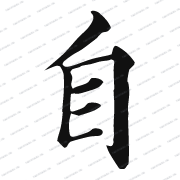
自 (zì) — Self
Single-character Chinese tattoo · verified meaning · autonomous & free
Browse all 自 glyphs ↗Meaning & Nuance
自 (zì) means “self,” “from,” and “naturally.” It is a pictograph of a nose—the center of the face we point to when referring to ourselves—so “self” grew from “nose / my.” In 自己 (oneself), 自由 (freedom), and 自然 (nature / natural) it anchors ideas of autonomy and authenticity. It differs from 我 (wǒ, I) by being the reflexive “self” rather than the pronoun, and from 己 (jǐ) by also meaning “from / since.” A tattoo of self-direction.
Pronunciation & Form
Pinyin: zì — a fourth tone, a falling pitch that drops firmly, like a self-contained full stop. The tone's closure suits a word about self-sufficiency.
Common Words & Phrases
Why Get 自 as a Tattoo
自 is the character for “self” and “from”—a tattoo about autonomy, authenticity, and freedom (自由, freedom). It's elegant and compact, reading clearly as “self” to Chinese readers, and it pairs naturally with 我 or 己 for a fuller “self” theme. People choose 自 to mark independence, self-trust, or a return to their true nature. As a single glyph it's a quiet emblem of being your own source.
Tattoo Style & Placement
Best fits: fine-line, minimalist, or brush. 自 is simple and compact, working at small-to-medium sizes. Placements: wrist, forearm, collarbone, or rib. A small 自 on the wrist pairs well with 由 (自由, freedom) or 然 (自然); keep the top “nose” strokes clear. It also anchors a 自己 (oneself) pairing.
Authenticity & Cultural Note
Always confirm the character with a native speaker or linguist before inking. 自 (zì, self / from) is sometimes confused with 白 (bái, white) or 目 (mù, eye) by shape; handmade.ink verifies you get the “self” character.
Frequently Asked Questions
What does the Chinese character 自 mean?
How do you pronounce 自?
Is 自 a good tattoo for freedom or authenticity?
What words use the character 自?
How is 自 different from 我?
Why is 自 shaped like a nose?