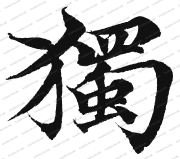
独 (dú) — Alone / Solitary
Single-character Chinese tattoo · verified meaning · fine-line & minimalist friendly
Browse all 独 glyphs ↗Meaning & Nuance
独 (dú) means “alone,” “solitary,” or “single” — but in Chinese it is not purely lonely; it can carry strength, independence, and self-sufficiency. 独立 (dúlì) is “independent,” and 独特 (dútè) is “unique.” As a tattoo it speaks to owning your own path rather than fearing solitude. It differs from 孤 (gū), which leans more toward the sad, abandoned side of “alone.”
Pronunciation & Form
Pinyin: dú — a second tone (rising). The character uses the 犭 (beast) radical on the left, hinting at a lone animal; the right portion is the phonetic component.
Common Words & Phrases
Why Get 独 as a Tattoo
独 is a strong single-character tattoo for “alone / solitary” that reads as independence rather than loneliness. It suits people who value self-reliance, solitude as recharge, or walking their own road. The character is balanced and inks cleanly, reading as “alone/independent” to Chinese readers. Many choose 独 to honor the strength of being comfortable with oneself.
Tattoo Style & Placement
Works in fine-line, minimalist, or bold brush styles — 独 holds up at small and medium sizes. Placements: inner forearm, collarbone, rib, upper back, or wrist. Pairs with 立 (lì) as 独立 or 特 (tè) as 独特. Size warning: keep the 犭 radical distinct at ~5 mm+.
Authenticity & Cultural Note
Always confirm the character with a native speaker or linguist before inking. 独 is often read in compounds like 孤独 (lonely) versus 独立 (independent) — confirm the nuance you want. handmade.ink meanings are checked by native Chinese linguists so your 独 reads exactly as “alone / solitary.”
Frequently Asked Questions
What does 独 mean in Chinese?
How do you pronounce 独?
Is 独 a good tattoo for 'solitude'?
What is the difference between 独 and 孤?
What words use 独?
Can 独 mean 'only'?