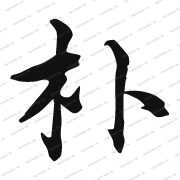
朴 (pǔ) — Simplicity
Single-character Chinese tattoo · verified meaning · fine-line & minimalist friendly
Browse all 朴 glyphs ↗Meaning & Nuance
朴 (pǔ) means “simple,” “plain,” or “unworked” — as in uncarved wood before it becomes a thing. It is the 朴 in 朴素 (pǔsù, plain and simple) and echoes the Daoist “uncarved block” (朴) that precedes all distinctions. As a tattoo it honors unpretentious living and natural honesty. It is closely related to 素 (sù) but 朴 stresses the “unshaped, natural” quality.
Pronunciation & Form
Pinyin: pǔ — a third tone (dipping, fall-then-rise). The character uses the 木 (wood) radical on the left, reinforcing its image of raw, unworked timber — simplicity before craft.
Common Words & Phrases
Why Get 朴 as a Tattoo
朴 is a grounded single-character tattoo for “simplicity” — ideal for someone who values honest, unshowy living over status or ornament. Drawn from the image of uncarved wood, it carries a Daoist calm that reads beautifully as ink. The character is compact and inks cleanly, reading as “simple/plain” to Chinese readers. People choose 朴 to mark a return to what's essential.
Tattoo Style & Placement
Best in fine-line, minimalist, or brush styles — 朴 is a small, balanced character that suits modest sizes. Placements: inner wrist, forearm, collarbone, rib, or upper back. Pairs with 素 as 朴素. Size warning: keep the 木 radical clear at ~5 mm+.
Authenticity & Cultural Note
Always confirm the character with a native speaker or linguist before inking. 朴 has other readings (e.g., 朴树 pòshù, a tree; Piáo as a surname), so confirm the pǔ “simplicity” sense is intended. handmade.ink meanings are checked by native Chinese linguists so your 朴 reads exactly as “simplicity.”
Frequently Asked Questions
What does 朴 mean in Chinese?
How do you pronounce 朴?
Is 朴 a good tattoo for 'simplicity'?
What is the difference between 朴 and 素?
What words use 朴?
Is 朴 a Daoist term?